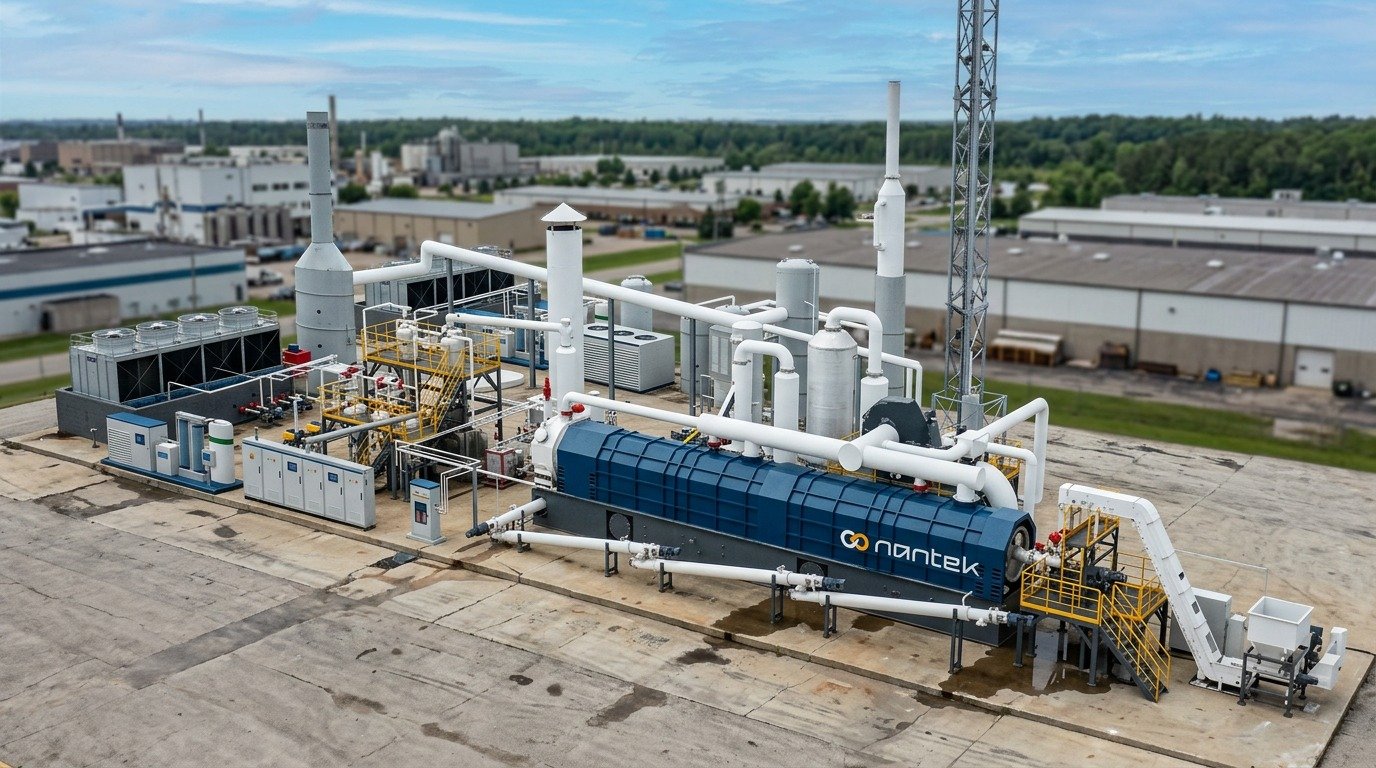
R-6000 pyrolysis plant. Continuous rotary reactor

R-6000 model

6,000 tonnes of plastic per year, continuously

Nantek R-6000 continuous pyrolysis plant with 310S stainless steel rotary reactor

The R-6000 turns between 15 and 20 tonnes of plastic waste per day into pyrolysis oil, continuously and without prior polymer sorting. It is designed for waste managers, landfills and large concessions that need an industrial solution for their plastic rejects.

Nantek designs, finances, installs and operates it on a turnkey basis, with the same pyrolysis technology that runs at the Bilbao plant.

6,000 t/year
15–20 t/day of plastic waste
~4,200 t/year
of pyrolysis oil (70%)
720 h
of continuous operation without shutdown
259 kW
of installed power
4–6 people
operators per shift
50 × 20 m
footprint, 9 m high

How it works

From waste to oil, without interruptions

The plastic, baled or shredded, enters the reactor through a weighing system and feed screws. From around 100 °C, vapours are generated and pass to the condensation system, where they liquefy and are stored as pyrolysis oil. The gas that does not condense is cleaned and returns to the burner as fuel for the reactor itself, and the flue gases are treated to meet emission regulations.

Technical advantages

Designed against the problems that stop a plant

No clogging in condensation

A wax recovery system that prevents condenser blockage, one of the main causes of downtime in continuous pyrolysis.

Mechanical coke removal

An internal structure removes coke from the reactor and maintains heat transfer: up to 720 h of continuous, stable operation.

Light and heavy oil

It separates the light and heavy oil fractions without the need for additional distillation equipment.

30% less energy

Hot flue gas recirculation and combustion air preheating: lower consumption, lower emissions and a longer furnace life.

Oxygen-free atmosphere

Nitrogen at the feed inlet and sealed discharge with a material seal. The self-adjusting seal withstands up to 3 kPa.

Automated and connected

Full-process control with PLC and remote monitoring included as standard, to minimise manual intervention.

Technical parameters

R-6000 technical data sheet

Capacity15–20 t/day of plastic waste (pellets or shredded) · ~6,000 t/year
Process typeContinuous thermal pyrolysis in a horizontal rotary reactor
Reactor material310S stainless steel (304/310S option)
Reactor dimensionsφ 1,800 × 19,200 mm · 16 mm thick
Continuous operation720 h without shutdown
Service life8–10 years
Installed power259 kW (standard configuration)
HeatingRecirculated hot air, burner of up to 2.5 Mkcal/h
FuelDiesel, fuel oil or natural gas at start-up; process gas and pyrolysis oil in steady state
SealingSelf-adjusting high-temperature seal, up to 3 kPa
Required area50 × 20 m · maximum height 9 m
Staff4–6 operators per shift
Accepted plasticsAll except PET, including film and mixed plastic
ControlPLC with remote monitoring (IoT) as standard

Modular installation: several R-6000 lines on one site

The R-6000 is modular. For larger volumes, several lines are installed in series on the same site, and capacity grows in blocks of 6,000 t/year.

ConfigurationCapacity
1 × R-60006,000 t/year
2 × R-600012,000 t/year
3 × R-600018,000 t/year
4 × R-600024,000 t/year

And so on: each additional line adds 6,000 t/year.

Equipment

Nine systems, a single line

SystemWhat it includes
FeedingContinuous weighing (0–2 t/h), steep-angle belt conveyor and feed screw with variable-speed drive
ReactorRotary reactor with riding rings, coke removal, ceramic fibre insulation and 15 kW drive with variable-speed control
HeatingBurner of up to 2.5 Mkcal/h, air preheater, induced-draught fan (14,000 Nm³/h) and flame arrester
InertingNitrogen generator, 0–50 m³/h
Solids dischargeWater-cooled discharge screws with material-level seal
Gas scrubbing5 m³ spray tank, primary and secondary scrubbing towers and wax recovery
CondensationPrimary and secondary condensers, gas-liquid separator, water seals and 7.5 m³ oil tank
CoolingThree cooling towers and circulation pumps
ControlSmart PLC cabinet with remote monitoring

Quality

Tested at the factory and at your plant

Factory tests

Weld inspection with non-destructive testing, pressure and leak tests, furnace runout check and rotation tests of screws and fans.

On-site tests

Verification of assembly, leak-tightness, electrical checks, a dry run of at least 2 h and testing of safety functions and emergency shutdown.

Documentation

As-built drawings (P&ID, electrical, layout and foundation), operation and maintenance manuals, test reports and operator training.

Certified in Europe

Certified plants and product

ISCC PLUS

The Bilbao plant converts mixed plastic waste into circular pyrolysis oil, under mass balance. Issued by CGN.

ISCC-PLUS-Cert-ES216-20247068

REACH registration with ECHA

Nantek's pyrolysis oil is registered in the European Union for more than 1,000 t/year.

01-2120087458-42-0010 · 17/05/2024

Frequently asked questions

What we are asked most about the R-6000

How much waste does the R-6000 process?

Between 15 and 20 tonnes of plastic waste per day, about 6,000 tonnes per year in continuous operation.

How much pyrolysis oil does it produce?

As a reference, around 70% of the incoming plastic becomes oil: about 4,200 tonnes per year.

How much space does it need?

An area of 50 × 20 metres with a maximum height of 9 metres.

How many people are needed to operate it?

Between 4 and 6 operators per shift. The process is automated with PLC and remote monitoring.

Which plastics does it accept?

All plastics except PET, including film and mixed plastic, without prior sorting by polymer.

How long does it take to commission?

Nantek delivers the plant turnkey in about 10 months.

Can capacity go above 6,000 t/year?

Yes. The R-6000 is modular: several lines are installed on the same site. Two lines process 12,000 t/year, three 18,000 t/year and four 24,000 t/year.

Got plastic waste? Give it a second life.