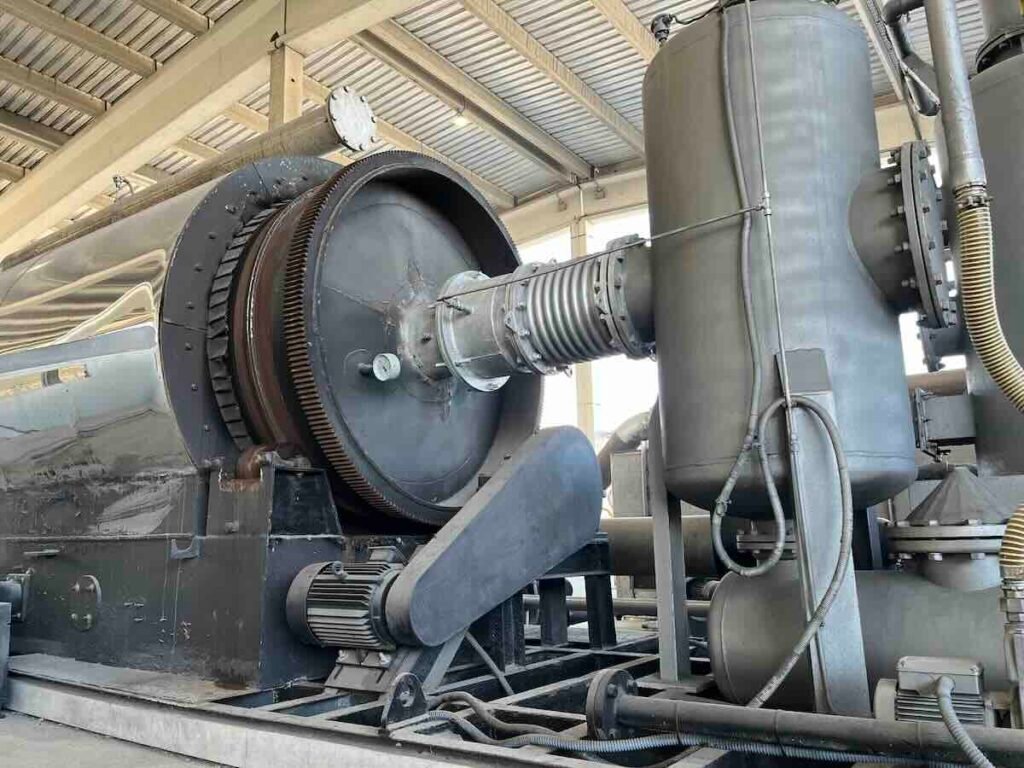
When people talk about plastic waste pyrolysis, they tend to think only about getting rid of waste. But the real value of the process lies in what it produces. Pyrolysis does not destroy plastic: it transforms it into three products with industrial and energy value. The most important is pyrolysis oil, also known as plastic pyrolysis oil, a feedstock that the petrochemical industry already uses to make new plastic. In this guide we explain what each product is, what its characteristics are and what it is used for.
What products pyrolysis generates
When plastic is heated without oxygen, its polymer chains break and turn into vapour. Cooling those vapours yields three fractions:
- Pyrolysis oil: the liquid fraction that condenses. It is the main product.
- Pyrolysis gas: the fraction that does not condense at room temperature.
- Char: the carbonaceous solid residue left in the reactor.
The proportion of each depends on the type of plastic, the temperature and the time the material spends in the reactor. With polyolefins (polyethylene and polypropylene) and a well-tuned process, oil accounts for more than half of the weight of the waste treated. If you want to see the full process, we explain it in what pyrolysis is and how it works.
What pyrolysis oil is
Pyrolysis oil is a liquid made up of hydrocarbons obtained by condensing the vapours leaving the reactor. As plastic is made from crude oil, breaking it down recovers molecules very similar to those in crude oil fractions: carbon and hydrogen chains of different lengths.
That is why it is often described as a product similar to naphtha or diesel. The comparison is useful but not exact: its composition depends on the input plastic. Polyethylene and polypropylene give an oil rich in paraffins and olefins, while polystyrene produces a more aromatic oil.
Pyrolysis oil and pyrolytic oil: are they the same?
Yes. They are two names for the same product. The English acronym PPO (plastic pyrolysis oil) is also used. It should not be confused with tyre pyrolysis oil, which comes from a different feedstock and has a different composition, nor with biomass pyrolysis bio-oil, which contains a lot of oxygen and water.
What pyrolysis oil is used for
The oil has two main outlets, and the first is the one that has transformed the market in recent years.
1. Feedstock for making new plastic
Petrochemical companies can feed pyrolysis oil into their steam crackers, the units that produce the ethylene and propylene that are then turned into polyethylene and polypropylene. In this way, used plastic becomes plastic again with the same quality as virgin material, including food-contact grade.
This is already happening in Spain. Repsol began using oils derived from plastic waste unsuitable for mechanical recycling as a feedstock in 2015, on an experimental basis, and obtained ISCC PLUS certification for the production of circular polyolefins at its Puertollano complex in 2019, followed by Tarragona and Sines.
2. Industrial fuel
The oil can also be refined into fuels or used directly as an alternative fuel in certain industrial applications. It is a valid outlet, but the trend in both the market and regulation is to prioritise its use as a feedstock, because it closes the material loop instead of burning it.
What quality industry requires of pyrolysis oil
Not all oil is worth the same. To go into a steam cracker, the oil must meet strict specifications, because some components damage equipment or poison the petrochemical plant’s catalysts. The most closely monitored parameters are:
- Chlorine and other halogens: they come mainly from PVC. They generate corrosive compounds, so their content has to be very low.
- Nitrogen and oxygen: they come from engineering plastics, inks, adhesives or organic residues.
- Metals and solids: from additives, pigments or impurities in the waste.
- Olefins and dienes: they are reactive and can cause fouling in equipment.
- Distillation curve: the boiling range has to fit what each cracker can accept.
Each petrochemical company has its own limits, and the oil often undergoes pre-treatment, such as hydrotreating, before entering the unit. That is why quality at source is so important: the cleaner the oil leaves the reactor, the less treatment it needs and the more it is worth. Control of the waste input and the design of the process make the difference.
Pyrolysis gas: the energy that powers the plant
Pyrolysis gas is a mixture of light hydrocarbons, such as methane, ethane, propane and butanes, together with small amounts of hydrogen. It has a high calorific value.
Its most common use is as fuel to heat the reactor itself. In this way the plant reduces its external energy consumption and its carbon footprint. In larger facilities, the surplus can be used to generate heat or electricity for other processes.
Char: the solid residue
Char is the carbon-rich solid fraction left at the end of the process. As well as carbon, it concentrates the inert materials that arrived with the waste, such as mineral fillers, paper residues or small impurities.
In a well-tuned plant it is a minor fraction. Depending on its composition, it can be disposed of as waste or recovered, for example as a solid fuel or in industrial applications that make use of its carbon content.
Summary: the three products at a glance
| Product | State | What it is | Main use |
|---|---|---|---|
| Pyrolysis oil | Liquid | Mixture of hydrocarbons similar to crude oil fractions | Petrochemical feedstock for making new plastic |
| Pyrolysis gas | Gas | Light hydrocarbons and hydrogen | Energy for the process itself |
| Char | Solid | Carbonaceous residue with inerts | Disposal or recovery as a solid |
Why demand for pyrolysis oil is growing
The EU Packaging and Packaging Waste Regulation (PPWR) requires plastic packaging to contain a minimum percentage of recycled plastic from 2030, rising in 2040. In polyolefin packaging that comes into contact with food, mechanical recycling can hardly reach the required quality. Chemical recycling can, because the plastic is rebuilt from the molecule up.
This makes pyrolysis oil a strategic feedstock. Petrochemical companies need stable, certified volumes, and today there are few producers able to supply them. We explain this in what chemical recycling is and how it differs from mechanical recycling.
How the oil is certified and monetised
For plastic made from the oil to be sold as recycled, the entire chain has to be traceable. The most widespread scheme is ISCC PLUS, which works on a mass balance basis: the amount of recycled material entering the chain is accounted for and allocated to the end products.
That certification allows the oil to be sold at a higher value and also generates monetisable environmental credits. We go into detail in ISCC PLUS and environmental credits: how to certify and monetise the pyrolysis output.
Nantek’s pyrolysis oil
Since 2022 Nantek has operated an industrial plant in the Port of Bilbao, where it produces pyrolysis oil from plastic waste from a range of sources. Its process is thermal pyrolysis without catalysts, using in-house developed reactive agents, and it accepts mixed plastic without prior sorting by type. Nantek holds ISCC and ISCC PLUS certification.
In its end-to-end model, a client who installs a plant does not have to look for a buyer for the oil: Nantek offers guaranteed offtake of 100 % of the product under long-term contracts and manages the certification of the environmental credits. You can see the capacities available in our range of industrial plants.
Frequently asked questions about pyrolysis oil
Is pyrolysis oil a fuel?
It can be used as a fuel, but its most valuable use is as a feedstock for making new plastic in the petrochemical industry.
How much oil is obtained from a tonne of plastic?
It depends on the type of plastic and the process. With polyolefins and an optimised process, more than half of the weight is obtained as oil. PET, on the other hand, yields very little oil.
Who buys pyrolysis oil?
Mainly petrochemical companies, which feed it into their crackers to produce monomers and, from them, new plastic certified as recycled.
What is the difference between plastic pyrolysis oil and tyre pyrolysis oil?
They come from different feedstocks. Tyre oil contains more sulphur and aromatic compounds, and has other uses and specifications.
Why does chlorine matter in pyrolysis oil?
Because it generates corrosive compounds that damage petrochemical equipment. That is why the presence of PVC in the input waste is controlled.
Do you generate plastic waste and want to know how much oil you could produce? Contact Nantek and we will assess your waste stream, the technical feasibility and the financial structure of the project.