Chemical recycling in Spain is in a transition phase: there are few operating plants and they are modest in size, but there is a growing pipeline of projects with environmental permits or going through approval. Spain’s Waste Law 7/2022 already recognises it in the plastic tax, the landfill tax makes the alternative more expensive and the EU packaging regulation is driving demand for recycled content. This article sums up the figures, the legal framework, the map of plants and what is still holding the sector back.
The technical explanation is in chemical versus mechanical recycling. Here we focus on Spain.
How much plastic Spain generates and where it goes
The most detailed official data is for packaging. According to Eurostat, in 2023 Spain generated 1,836,793 tonnes of plastic packaging waste. Of this:
- 847,686 t was recycled, a rate of 46.2 %. In 2022 the rate was 41.2 %.
- 292,479 t, around 16 %, went to energy recovery.
- Some 697,000 t, almost 38 %, is recorded as neither recycled nor recovered. In practice, most of that fraction ends up in landfill.
The target under Royal Decree 1055/2022 is to recycle 50 % of plastic packaging by 2025 and 55 % by 2030. On the 2023 figures, Spain was still around four points short of the first threshold. The European Environment Agency had already flagged plastic as the only packaging material that in 2022 was below the 2025 target.
Looking at all post-consumer plastic, not just packaging, the Plastics Europe report with 2022 data puts Spain’s recycling rate at 38 %, the second best in Europe. But it also notes that 39 % still goes to landfill, compared with a European average of 25 %.
The picture for municipal waste is similar. In 2022, Spain landfilled 50 % of its municipal waste and incinerated 11 %, according to the European Environment Agency. The target for 2035 is no more than 10 % to landfill. We analyse this in zero landfill by 2035.
This is mixed, dirty or multilayer plastic that mechanical recycling cannot absorb: the natural stream for chemical recycling of plastics.
Legal framework: what Spain’s waste law says about chemical recycling
Law 7/2022: hierarchy and definition of recycling
Law 7/2022 on waste and contaminated soils for a circular economy sets out the waste hierarchy in Article 8: prevention, preparing for reuse, recycling, other recovery (including energy recovery) and disposal. Chemical recycling sits on the recycling rung only when the product becomes material again.
The definition of recycling in Article 2 excludes energy recovery and reprocessing into materials that are to be used as fuels. That is why it must be shown that the oil obtained is used to make new chemicals or plastics.
Tax on non-reusable plastic packaging
The tax charges 0.45 euros per kilo on the non-recycled plastic contained in packaging. Under Article 77 of the law, recycled plastic does not form part of the tax base, and this expressly includes chemically recycled plastic, provided it is accredited with a certificate from an accredited body. Spain’s Directorate-General for Taxation (DGT) confirmed this in binding ruling V0931-25 of May 2025.
This is where the waste law and chemical recycling intersect most clearly: every kilo of certified chemically recycled content saves the packaging manufacturer tax. Whether that saving is recognised through mass balance depends on certification, a subject we cover in mass balance in chemical recycling.
Landfill and incineration tax
The same law created a state tax on landfilling, incineration and co-incineration of waste. Article 93 sets, among others, these rates:
- €40/t for municipal waste sent to non-hazardous waste landfill.
- €30/t for rejects from municipal waste treatment sent to that same landfill.
- Between €10 and €20/t for incineration, depending on the type of operation and waste.
The autonomous communities (Spain’s regional governments) can increase them, and the landfill gate fee comes on top. We calculate the total cost per tonne in the cost of not recovering waste.
Royal Decree 1055/2022 on packaging
Besides the recycling targets mentioned above, it requires all packaging to be recyclable by 2030 and sets separate collection targets. More collection means more rejects at sorting plants, and those rejects need a destination other than landfill.
The PPWR as a driver of demand
Regulation (EU) 2025/40 on packaging, which has applied since 12 August 2026, requires minimum recycled content in plastic packaging from 2030. For polyolefin packaging in contact with food, mechanical recycling can contribute very little material, and that is where chemical recycling comes in. We explain it in detail in the PPWR and recycled content in 2030.
Map of chemical recycling plants in Spain
The table lists the chemical recycling plants in Spain with a public source. Where the current status is not confirmed, we say so.
| Company | Location | Technology | Capacity | Status as of October 2026 |
|---|---|---|---|---|
| Nantek | Port of Bilbao | Catalyst-free thermal pyrolysis | Industrial validation plant | Operating since 2022 |
| Nantek with Sadeco | Córdoba | Catalyst-free thermal pyrolysis | 16,000 t/year in the first phase; up to 54,000 t/year | Agreement signed in 2025; under development |
| Plastic Energy | El Ejido (Almería) | Pyrolysis | Not published by the company | Operating since 2016 |
| Plastic Energy | Alcalá de Guadaíra (Seville) | Pyrolysis | Not published by the company | Operating since 2017 |
| Plastic Energy and TotalEnergies | Seville | Pyrolysis | 33,000 t/year | Announced in 2022 for 2025; no record of start-up |
| 2G Chemical Plastic Recycling | Ascó (Tarragona) | Pyrolysis | 7,500 t/year; expansion to 15,000 t/year | Operating; expansion announced in 2024, not confirmed whether completed |
| Repsol (Recpur plant) | Puertollano (Ciudad Real) | Acidolysis of polyurethane foam | 2,000 t/year of waste | Started up in 2024, according to Repsol |
| Repsol (Ecoplanta, Enerkem technology) | El Morell (Tarragona) | Gasification of municipal waste to methanol | Up to 400,000 t/year | Investment approved in 2025; operation expected in 2029 |
| Valogreene (Greene Enterprise) | Puertollano (Ciudad Real) | Pyrolysis | 40,000 t/year | Favourable environmental impact statement (2025) and land acquired (2026) |
| Reciclaje Circular Guijuelo | Guijuelo (Salamanca) | Pyrolysis | 10,600 t/year | Environmental permit granted in 2026; awaiting construction |
| WPI Huelva | Palos de la Frontera (Huelva) | Pyrolysis and distillation | 320,000 t/year in two phases | Declared a strategic investment by the Andalusian regional government in 2023; current status not confirmed |
| Valoriza (Sacyr) | Jerez de la Frontera (Cádiz) | Pyrolysis | Around 20,000 t/year | At project stage; no confirmed date |
| COGERSA and University of Amsterdam | Asturias | Solvothermal liquefaction | Pilot plant | Start-up expected in summer 2026 |
Two caveats. Plastic Energy’s UK parent company entered insolvency proceedings in May 2026, but the Spanish company that operates Almería and Seville was not included and continues to operate. And on the demand side, Moeve (formerly Cepsa) carried out Spain’s first co-processing trial of plastic pyrolysis oil in Huelva in 2023, to produce circular phenol and acetone.
The picture is of a sector with little installed capacity and a great deal announced, which remains active while in other European countries plants have closed and projects have been cancelled in 2025 and 2026.
Barriers to chemical recycling in Spain
- Approvals and permits. Regional environmental permit, impact assessment and municipal licences. The projects in the table take years to get from announcement to construction.
- End-of-waste status. Order TED/646/2023 only sets criteria for mechanically treated thermoplastics. There is no national criterion for pyrolysis oil, so each autonomous community can decide case by case in the permit, as Article 5 of Law 7/2022 allows. That lack of consistency makes it harder to sell the product across regions.
- Financing. Capital-intensive investments and technologies that are still scaling up. Recent European closures have made financiers more demanding.
- Waste supply. A stable stream in quantity and composition is needed for years. Without supply contracts, the project is not bankable.
- Social acceptance. Environmental organisations question the fact that part of pyrolysis output ends up as fuel. Explaining the product’s destination and the emissions clearly is part of the project.
Opportunities for waste managers, landfills and industry
- Savings compared with landfill. Every tonne of plastic rejects that does not go into a cell avoids the €30 or €40/t tax, the gate fee and the use of increasingly scarce void space. It is the central argument for landfills and large waste managers.
- Demand for recycled content. The chemical industry needs certified recycled feedstock for the PPWR and the plastic tax, particularly for food-grade polyolefins.
- Public targets. Municipalities and concession holders must cut landfill to 10 % by 2035 without relying solely on incineration.
- Industry with captive waste. Anyone generating their own plastic can turn a management cost into a product with a buyer.
Where Nantek fits into chemical recycling in Spain
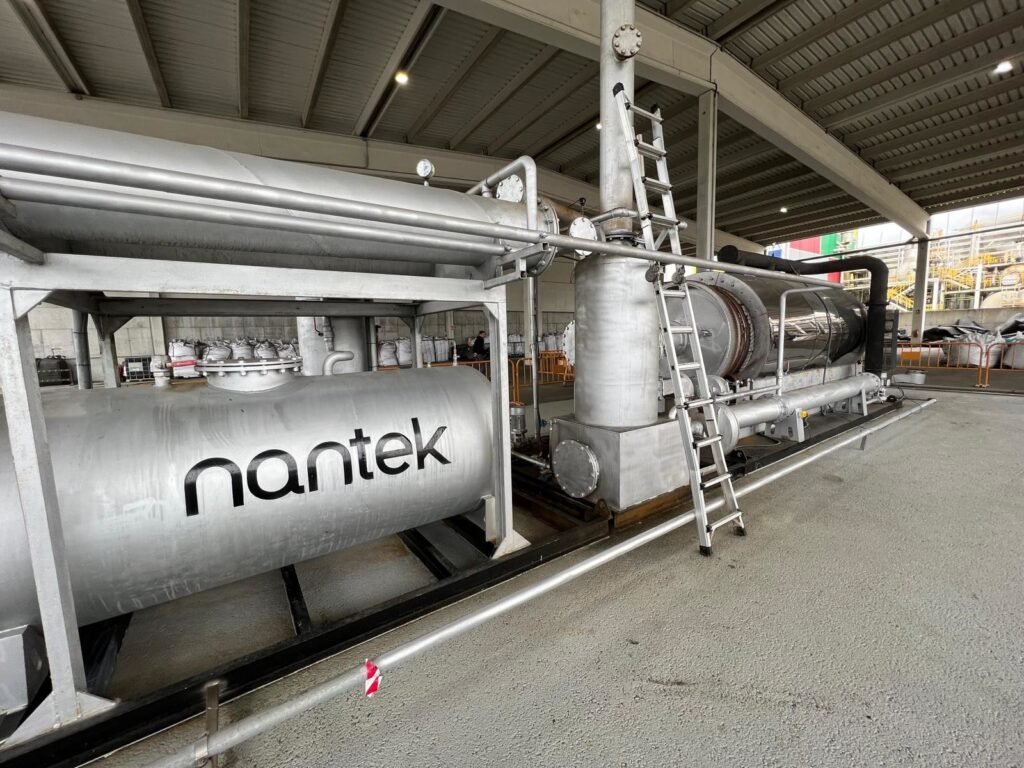
Since 2022 Nantek has operated an industrial plant at the Port of Bilbao, where it has validated its technology with plastics from a range of sources. Its process is catalyst-free thermal pyrolysis, using reactive agents developed in-house, and it accepts mixed plastic without first sorting it by type.
In Córdoba, in 2025 Nantek signed an agreement with Sadeco and the City Council for a plant of 16,000 t/year in its first phase, with an investment of €22 million, and a planned expansion to 54,000 t/year, with €65 million in total. The project details are in the press release on the Córdoba plant.
Its end-to-end model addresses the barriers in the previous section:
- Modular plants from 1,500 to 16,000 t/year, with turnkey EPC at fixed scope and price.
- Structured financing of up to 70 % of the investment.
- Remotely monitored operation and maintenance with proprietary software.
- Guaranteed offtake of 100 % of the product through long-term contracts.
- Management of environmental credit certification, with part of the net profit passed on to the client. Nantek’s website shows ISCC, ISCC PLUS and CGN certifications, and it holds ECHA registration.
Frequently asked questions about chemical recycling in Spain
Is chemical recycling legal in Spain?
Yes. It is a recycling operation under Law 7/2022 provided the product is used as a material and not as a fuel. Each plant needs its regional environmental permit.
How many chemical recycling plants are there in Spain?
Few in operation: Nantek’s in Bilbao, Plastic Energy’s in Almería and Seville, 2G’s in Ascó and Repsol’s in Puertollano, among others. There are at least half a dozen more projects, announced, permitted or going through approval.
Does chemically recycled plastic pay the plastic tax?
No, if it is accredited with a certificate from an accredited body. The law excludes it from the tax base of the €0.45/kg tax.
Does pyrolysis oil cease to be waste?
It can, but there are no national criteria for this product. Today the autonomous community decides in each plant’s permit.
What savings does it offer compared with landfill?
At a minimum, the state tax of €30 or €40/t, plus the landfill gate fee and any regional surcharges. On top of that comes the sale of the product.
Do you manage a plastic rejects stream in Spain and want to know whether it is enough for a plant? Get in touch and we will review the volume, composition and financial structure of the project with you.