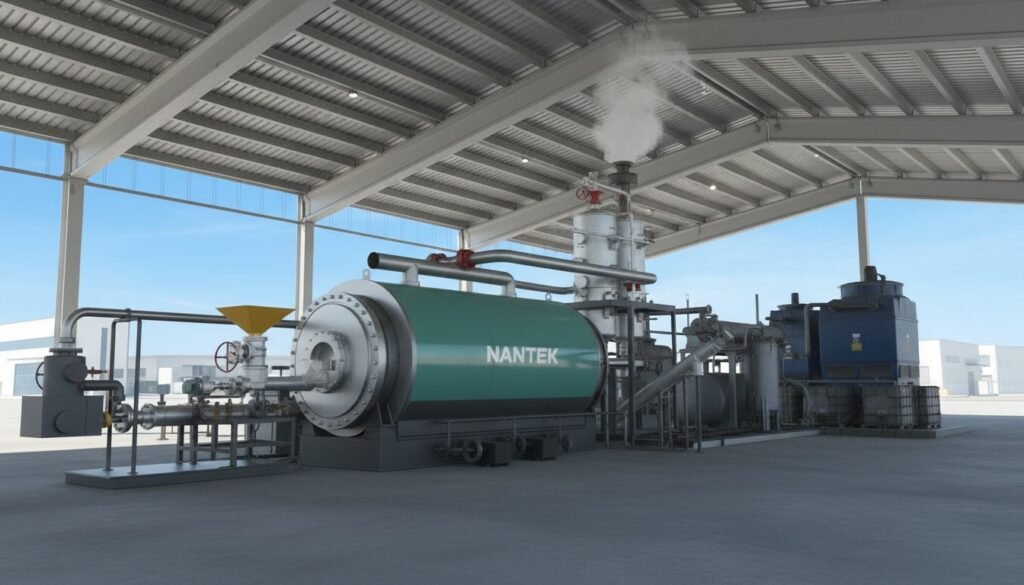
Plastic waste pyrolysis has become one of the most robust ways to solve a problem that conventional recycling cannot tackle: what to do with plastic that cannot be mechanically recycled and that today ends up in landfill or at the incinerator. In this guide we explain what pyrolysis is, how it works step by step, which plastics it accepts, what products it generates and why European regulation is placing it at the heart of waste management.
What pyrolysis is
Pyrolysis is a process of thermal decomposition in the absence of oxygen. The term comes from the Greek pyro (fire) and lysis (separation): heat is used to break a material down into simpler compounds. Because there is no oxygen, the material does not burn. Instead of combusting, its molecules break apart.
Applied to plastics, pyrolysis breaks the long polymer chains (polyethylene, polypropylene, polystyrene…) into shorter hydrocarbons. The result is a pyrolysis oil with a composition similar to petroleum fractions, a combustible gas and a small carbonaceous solid fraction called char. Put simply, it returns plastic to a state similar to that of the raw material it came from.
That is why pyrolysis is classed as chemical recycling, unlike mechanical recycling, which shreds and remelts plastic without changing its chemical structure. If you want to dig deeper into that difference, we explain it in what chemical recycling is and how it differs from mechanical recycling.
How plastic pyrolysis works, step by step
Although each technology has its own particularities, a plastic waste pyrolysis plant always follows a similar sequence:
- Waste reception and preparation. The plastic arrives in bales or in bulk. It is shredded to standardise its size, and items that must not enter the reactor, such as metals or stones, are removed.
- Feeding the reactor. The material enters a sealed, oxygen-free reactor, where it is heated in a controlled way.
- Thermal cracking. Typically at between 400 and 600 °C, the polymer chains break and the plastic turns into vapour.
- Condensation. The vapours are cooled and most of them condense as pyrolysis oil. The fraction that does not condense is the pyrolysis gas.
- Use of the gas. The gas is usually reused as fuel to heat the reactor itself, which reduces the plant’s external energy consumption.
- Removal of the solid. The carbonaceous residue (char) is extracted from the reactor for disposal or reuse.
The temperature, the residence time of the material in the reactor and the heating rate determine the proportion of each product obtained. In general, the higher the temperature, the more gas is produced. Fine-tuning these variables is what sets a profitable technology apart from one that is not.
Types of pyrolysis
- Slow pyrolysis: gradual heating and long residence times. It favours the solid fraction. It is the most common approach with biomass.
- Fast pyrolysis: very rapid heating and short residence times. It maximises the liquid fraction, which is what matters when the aim is to obtain oil from plastic.
- Thermal versus catalytic pyrolysis: in catalytic pyrolysis a catalyst is added to steer the reactions towards certain products. Thermal pyrolysis does without one, which simplifies operation and avoids the cost and wear of the catalyst.
Which plastics can be treated by pyrolysis
Not all plastics behave the same way in the reactor. The best-performing are polyolefins and polystyrene, which together make up most packaging plastic and most of the rejects from sorting plants:
- Polyethylene (PE, high and low density): film, bags, flexible packaging. Very good oil yield.
- Polypropylene (PP): caps, rigid packaging, industrial packaging. Very good yield.
- Polystyrene (PS): trays, single-use packaging, expanded polystyrene. One of the highest oil producers.
There are two plastics whose presence in the feedstock should be limited:
- PET: it yields very little oil through pyrolysis and also has a well-established mechanical recycling loop, so there is no point in diverting it.
- PVC: it contains chlorine, which generates corrosive compounds during the process. Its presence must be controlled.
The great advantage of pyrolysis is that it accepts mixed plastics and dirty or multilayer waste that mechanical recycling rejects: packaging with organic residues, films combined with other materials, agricultural plastic or the final rejects from sorting plants. This is precisely the stream that ends up in landfill today.
What pyrolysis produces: oil, gas and char
A well-optimised process running on polyolefins can convert more than half of the weight of the waste into oil. The three products are:
- Pyrolysis oil (or plastic pyrolysis oil): this is the main product. Its value lies in the fact that petrochemical companies can use it as a feedstock to make new plastics, replacing part of the virgin crude oil. It can also be refined into fuels.
- Pyrolysis gas: a mixture of light hydrocarbons that is used as an energy source in the plant itself.
- Char: a carbon-rich solid fraction, which is minor when the process is well tuned.
We detail their characteristics and uses in pyrolysis oil, gas and char: what products pyrolysis generates and what they are for.
Pyrolysis, incineration and landfill: how they differ
| Landfill | Incineration | Pyrolysis | |
|---|---|---|---|
| What happens to the plastic | It is buried | It is burned with oxygen | It is decomposed without oxygen |
| Product | None | Heat and electricity, ash | Oil, gas and char |
| Does it return to the value chain? | No | Not as material | Yes, as feedstock |
| Regulatory fit | Increasingly restricted | Energy recovery | Chemical recycling |
The key difference is that incineration destroys the material to obtain energy, whereas pyrolysis recovers it as feedstock. We go into this in pyrolysis vs incineration: why recovery is not the same as burning.
Why pyrolysis matters now: the regulatory context
Three factors are changing the economics of plastic waste:
- Directive (EU) 2018/850 on the landfill of waste: by 2035, at most 10 % of municipal waste may be landfilled, with restrictions from 2030 on landfilling waste suitable for recycling or recovery. We analyse it in zero landfill by 2035: what the EU requires and how to prepare.
- Regulation (EU) 2025/40 on packaging and packaging waste (PPWR): in force since February 2025, it requires plastic packaging to contain a minimum percentage of recycled plastic from 2030, between 10 % and 35 % depending on the polymer and the use, and between 25 % and 65 % in 2040. In polyolefin packaging that comes into contact with food, mechanical recycling can hardly reach the required quality, and this is where chemical recycling via pyrolysis becomes decisive.
- Rising cost of landfill: increasing per-tonne fees and taxes that turn waste into a financial liability. We run the numbers in the cost of not recovering waste.
The result is growing demand for pyrolysis oil from the petrochemical industry, which needs certified recycled feedstock to meet its targets. That traceability is demonstrated through schemes such as ISCC PLUS, which we explain in ISCC PLUS and environmental credits.
Advantages and limitations of pyrolysis
Advantages
- It treats the plastic that mechanical recycling cannot use: mixed, dirty or multilayer.
- It returns the carbon in plastic to the value chain instead of emitting it or burying it.
- It reduces landfill occupancy and extends the useful life of existing cells.
- It generates a product with a market and value, not just a disposal service.
- It is partly self-sufficient in energy thanks to the use of the gas.
Limitations to bear in mind
- It requires control of the input composition, especially PVC.
- Profitability depends on the volume of waste available, the selling price of the oil and the avoided landfill costs.
- It requires investment in the plant, permits and a stable buyer for the product.
These limitations relate mainly to the business model, not the technology. That is why the success of a pyrolysis project depends as much on the financing and the oil offtake agreement as on the reactor. We explain this in how a pyrolysis plant is financed.
Who a pyrolysis plant makes sense for
- Landfills and large waste managers, who need to reduce the rejects sent to cells and protect their concession. See pyrolysis for landfills and large waste managers.
- Industry with captive plastic waste, which generates its own constant stream of plastic. See pyrolysis for industry with captive waste.
- Public authorities and concession holders who must meet the 2035 landfill targets. See solutions by sector.
Nantek’s pyrolysis
Since 2022 Nantek has operated an industrial plant in the Port of Bilbao, where it has validated its technology with plastics from a range of sources. Its process is thermal pyrolysis without catalysts, using in-house developed reactive agents, and it accepts mixed plastic without the need to sort it by type before it enters the reactor.
On that basis, Nantek offers a range of modular plants from 1,500 to 16,000 tonnes a year and an end-to-end model covering turnkey EPC (engineering and construction), structured financing, operation and maintenance, guaranteed offtake of the oil and management of the environmental credits. Its Córdoba plant, developed with Sadeco, will process 16,000 tonnes of plastic waste a year in its first phase.
For the regulatory context that is accelerating demand, read our analysis of the PPWR and recycled content in packaging and how mass balance works.
Frequently asked questions about pyrolysis
Is pyrolysis the same as burning plastic?
No. Combustion needs oxygen and destroys the material. Pyrolysis takes place without oxygen and breaks plastic down into oil, gas and char that can go back into industry.
At what temperature does plastic pyrolysis take place?
Normally between 400 and 600 °C. The exact temperature depends on the type of plastic and on whether the aim is to maximise oil or gas.
Does pyrolysis pollute?
Because the waste is not combusted, it does not generate the emissions typical of incineration. A well-designed plant works in a closed loop and uses its own gas. Like any industrial facility, it needs an environmental permit and emissions control.
Which plastics are not suitable for pyrolysis?
PET yields very little oil and is better recycled mechanically. PVC must be limited because of its chlorine content.
What is pyrolysis oil used for?
Mainly as a feedstock for petrochemical companies to make new plastics, replacing virgin crude oil. It can also be turned into fuels.
How much does a pyrolysis plant cost?
It depends on the capacity and the scope of the project. In Nantek’s model, financing can cover up to 70 % of the investment and the sale of the oil is guaranteed by contract. For an estimate for your case, contact the Nantek team.
Do you have a plastic waste stream and want to know whether it is viable for a pyrolysis plant? Request an assessment of the stream, the technical feasibility and the financial structure in a single step.